
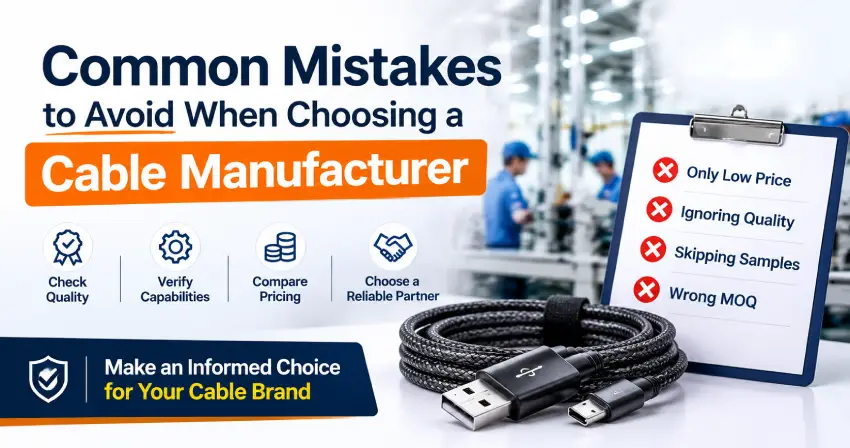
Choosing the right cable manufacturer is an important decision for businesses planning to launch their own cable brand, expand their product portfolio or source cables in bulk. The right manufacturing partner can help maintain product quality, manage production requirements, support customization and build a reliable supply chain. However, choosing a manufacturer without evaluating the important factors can lead to quality issues, unexpected costs, production delays and customer complaints.
For retailers, distributors, wholesalers, importers and private-label brands, the lowest quotation is not always the best option. Product specifications, manufacturing capabilities, testing procedures, minimum order quantities, packaging support and communication all play an important role in determining whether a manufacturer is suitable for a business.
Whether you need USB Type-C cables, charging cables, data cables or customized cable products, understanding common sourcing mistakes can help you make a better decision.
In this guide, we explain the most common mistakes to avoid when choosing a cable manufacturer and share practical steps to evaluate potential manufacturing partners before placing a bulk order.
Why Choosing the Right Cable Manufacturer Matters
A cable manufacturer does more than produce a finished product. The manufacturing partner can influence product consistency, customization options, production timelines, packaging quality and the overall purchasing experience.
For businesses selling under their own brand, these factors directly affect customer satisfaction and brand reputation.
A suitable manufacturer should be able to understand your product requirements, communicate clearly, provide samples when appropriate and maintain agreed specifications throughout production.
Before selecting a supplier, businesses should evaluate the complete manufacturing process rather than focusing on a single factor such as price or delivery time.
Also Read: How to Start Your Own Cable Brand: A Step-by-Step Guide
1. Choosing a Cable Manufacturer Based Only on Price
One of the most common mistakes businesses make is selecting a manufacturer simply because it offers the lowest quotation.
Price is important, especially for bulk buyers working with specific margins. However, an unusually low quotation may not reflect the same materials, product specifications, testing requirements, or packaging options offered by another manufacturer.
Two cables that look similar may differ in their internal construction, connector quality, charging capabilities, durability, and performance.
What Should You Check?
Before comparing quotations, confirm that each manufacturer is quoting for the same product specifications.
Consider the following factors:
- Cable type and connector configuration
- Supported charging capabilities
- Data transfer requirements
- Conductor and insulation specifications
- Outer jacket material
- Connector construction
- Packaging requirements
- Quality testing
- Applicable taxes and transportation costs
You should also calculate the total landed cost instead of comparing only the manufacturing price.
For example, a lower unit price may not provide better value if additional packaging, transportation, inspection, or rework costs make the overall purchase more expensive.
Best practice: Compare manufacturers based on equivalent specifications, expected product quality, service, and total cost.
2. Ignoring Product Quality and Testing
A cable may have an attractive appearance and competitive price but still fail to deliver consistent performance.
Poor-quality products can lead to charging problems, damaged connectors, premature cable failure, customer complaints, and increased returns.
For businesses building their own brands, repeated quality issues can affect customer trust and long-term sales.
What Should You Evaluate?
Depending on the product, quality evaluation may include:
- Charging performance
- Data transfer performance
- Connector compatibility
- Cable flexibility
- Connector strength
- Strain relief
- Insulation and outer jacket quality
- Durability under intended use
- Electrical safety where applicable
- Consistency between samples and production batches
The exact testing requirements depend on the cable design, intended application, specifications, and destination market.
Request product samples and understand the manufacturer’s quality control process before committing to a large order.
If your product is intended to support fast charging or a particular data transfer standard, make sure the relevant claims are verified rather than relying on appearance or marketing descriptions.
Best practice: Approve samples only after evaluating them against clearly defined product requirements.
3. Not Checking the Manufacturer’s Actual Capabilities
Not every cable manufacturer offers the same products, processes, customization options, or production capabilities.
A supplier may be suitable for standard charging cables but may not have the experience or processes required for a more specialized product.
Similarly, a manufacturer that handles small orders may not be the right fit for a business planning large-scale distribution.
Questions to Ask a Cable Manufacturer
Before making a decision, ask questions such as:
- Which types of cables do you manufacture?
- Can you support our required connector configurations?
- Do you offer private-label manufacturing?
- Can you manufacture according to our specifications?
- What customization options are available?
- What is your production capacity for the required product?
- How do you inspect finished products?
- Can you provide product samples?
- What documentation can you provide?
- What are your standard production timelines?
Where possible, review product samples, manufacturing information, and quality procedures.
If your order is substantial, consider whether a factory visit or an independent inspection would be appropriate.
Best practice: Match the manufacturer’s demonstrated capabilities to your actual product and order requirements.
Also Read: What Makes a High-Quality Data Cable? A Complete Buyer’s Guide
4. Overlooking MOQ and Production Capacity
Minimum Order Quantity, commonly called MOQ, refers to the minimum quantity a manufacturer is willing to produce or supply under specified conditions.
MOQ can vary depending on product type, customization, packaging, materials, and production requirements.
A business launching its first product may prefer a manageable quantity, while an established distributor may require a larger order with a dependable replenishment schedule.
Problems arise when buyers agree to an order quantity without understanding how it affects inventory, cash flow, and future purchasing.
What Should Businesses Consider?
Evaluate these factors before confirming an order:
- Minimum order quantity
- Quantity per product variant
- Quantity per color or connector type
- Customized packaging requirements
- Production lead time
- Capacity for repeat orders
- Stock availability, where applicable
- Payment terms
- Inventory storage costs
A manufacturer may offer a competitive unit price for a large order, but the savings may not justify the risk of holding products that sell slowly.
On the other hand, an order that is too small may increase per-unit costs or make customized packaging less practical.
Best practice: Choose an order quantity based on realistic demand forecasts, working capital, and expected inventory turnover.
5. Ignoring Customization and Private-Label Options
Businesses that want to build their own cable brands need more than a generic product.
They may require specific connector designs, cable lengths, colors, materials, branding, or packaging.
Selecting a manufacturer without checking its customization capabilities can limit future product development and make it difficult to differentiate your brand.
What Customization Options May Be Available?
Depending on the manufacturer and product, customization can include:
- Cable length
- Connector type
- Cable color
- Outer jacket finish
- Braided or non-braided construction
- Product branding
- Logo placement
- Customized packaging
- Retail box design
- Product specifications
- Special product configurations
Not every customization option is available for every cable. Some changes may require additional tooling, development work, testing, or minimum quantities.
Businesses should also clarify whether the project involves private labeling, manufacturing according to supplied specifications, or more extensive product development.
These approaches have different requirements and may involve different timelines and costs.
Best practice: Discuss your long-term product roadmap with the manufacturer instead of evaluating only the first product you intend to launch.
6. Overlooking Packaging and Branding Support
Packaging is an important part of the product experience, especially for brands selling through retail stores and e-commerce platforms.
Poor packaging can make a product difficult to display, store, transport, or identify. It can also create an inconsistent brand experience.
For private-label businesses, packaging communicates product specifications and helps customers distinguish one product from another.
What Should You Confirm?
Before placing your order, clarify whether the manufacturer can support:
- Custom packaging designs
- Brand logo printing
- Product labels
- Cable length and connector information
- Charging and data specifications
- Compatibility information
- Barcode placement
- Batch identification, where required
- Protective packaging for transportation
Also confirm who is responsible for artwork approval, packaging materials, printing, and final inspection.
Packaging should communicate accurate product information. Avoid making unsupported claims about charging speed, compatibility, or performance.
Best practice: Finalize the product and packaging specifications together so that both remain consistent throughout production.
Also Read: Custom Cable Packaging: Why Packaging Matters for Private Label Brands
7. Not Evaluating Communication and Delivery Timelines
Clear communication is essential when sourcing products from a manufacturer.
Even a technically capable supplier can become difficult to work with if requirements are misunderstood, approvals are delayed, or production updates are unclear.
These problems become more serious when the product has customized specifications or a scheduled market launch.
What Good Communication Looks Like
A reliable manufacturing process should establish clear expectations around:
- Product specifications
- Sample approval
- Packaging artwork
- Quotation and payment terms
- Production milestones
- Quality inspection
- Dispatch arrangements
- Delivery estimates
- Handling of defects or discrepancies
You should also clarify what happens if the production schedule changes or a sample requires modification.
Delivery estimates should be confirmed in writing, along with the conditions that may affect them.
For international orders, allow additional time for transportation, customs clearance, and other applicable logistics procedures.
Best practice: Agree on responsibilities, approvals, and timelines before production begins.
8. Ignoring Certifications and Compliance Requirements
Product compliance is another important consideration when choosing a cable manufacturer.
Requirements vary by product type, intended use, country, and applicable regulations. A cable sold in one market may face different requirements in another.
Businesses should not assume that every cable requires the same certifications or that a manufacturer’s general certification automatically covers every product.
What Should You Check?
Depending on the product and target market, review:
- Applicable product safety requirements
- Electrical and performance standards
- Required testing reports
- Product labeling requirements
- Packaging and documentation obligations
- Import and export requirements
- Relevant environmental regulations
- Claims involving charging or data standards
Ask the manufacturer what documentation is available for the specific product you intend to purchase.
Where necessary, consult an appropriate testing laboratory or compliance professional to confirm the requirements for your target market.
Best practice: Identify compliance requirements before finalizing the product design and production order.
9. Failing to Compare Samples With Mass Production
Approving a sample is important, but businesses should also ensure that mass production follows the approved specifications.
A sample may look and perform as expected, while inconsistencies in later batches can create problems for distributors and retail customers.
This is particularly important for businesses ordering large quantities or selling products under their own brand.
How Can You Reduce This Risk?
Before production, establish a clear reference for the approved product.
This may include:
- Final technical specifications
- Approved physical samples
- Product appearance and color
- Packaging artwork
- Required performance criteria
- Agreed inspection procedures
- Acceptance criteria for defects
For larger orders, consider a defined pre-shipment inspection process or independent inspection where appropriate.
Maintain records of approved specifications and communicate any changes before manufacturing begins.
Best practice: Treat sample approval as the beginning of quality control, not the end of it.
10. Not Checking the Manufacturer’s Experience With Bulk Orders
A manufacturer may produce good samples but still need to demonstrate that it can meet your requirements for repeat production.
Bulk orders introduce additional considerations, including production scheduling, material availability, inspection, packaging coordination, and delivery planning.
Businesses that rely on regular inventory replenishment should assess whether the manufacturer can support their expected purchasing pattern.
Questions Worth Asking
- What quantities can you produce for our product?
- How are production schedules planned?
- How do you manage product consistency across batches?
- What happens when a defect is identified?
- Can you support repeat orders?
- How are changes in specifications managed?
- What is the process for resolving quality disputes?
The answers should be specific to your product and order rather than based on general promises.
Best practice: Evaluate the manufacturer’s ability to support both your initial order and your anticipated future requirements.
Also Read: USB Type-C vs Lightning vs Micro USB: Which Cable Should You Choose?
How to Evaluate a Cable Manufacturer Before Placing an Order
Once you understand the common mistakes, create a structured evaluation process.
The following checklist can help businesses compare potential suppliers.
| Evaluation Factor | What to Check |
| Product range | Does the manufacturer support your required cable types? |
| Product quality | Are samples and testing procedures satisfactory? |
| Technical specifications | Can the manufacturer meet your requirements? |
| Customization | Are your branding and product changes feasible? |
| MOQ | Does the order quantity fit your budget and demand forecast? |
| Production capacity | Can the manufacturer meet your expected volumes? |
| Packaging | Can the supplier support your packaging requirements? |
| Compliance | Can relevant product documentation be provided? |
| Communication | Are requirements, updates, and responsibilities clear? |
| Delivery | Are production and delivery timelines realistic? |
| Cost | Have all major costs been considered? |
| Repeat orders | Can future production be planned reliably? |
You can use this checklist to score different manufacturers against the same criteria.
For example, assign each supplier a score from 1 to 5 for product quality, customization, communication, delivery, and total cost. This makes comparisons more objective and helps prevent price alone from determining your decision.
How Vizin Cables Supports Businesses Looking for Cable Manufacturing Solutions
Businesses looking to launch their own cable products or expand an existing product range should work with a manufacturing partner that understands their specifications, branding requirements and expected order volumes.
Vizin Cables works with businesses seeking cable manufacturing solutions for brand development, private labeling, customized requirements and bulk sourcing.
When evaluating a manufacturing project, businesses should clearly communicate the cable type, connector configuration, required specifications, branding preferences, packaging requirements and expected quantities.
This information helps establish whether the proposed product and manufacturing approach are suitable for the intended market.
Before confirming an order, buyers should review the relevant samples, specifications, quotation, production schedule and quality expectations.
A well-defined process helps both the buyer and manufacturer understand their responsibilities and reduces the likelihood of avoidable misunderstandings.
Why a Long-Term Manufacturing Partnership Matters
Choosing a manufacturer should not be treated as a one-time purchasing decision, particularly for businesses planning to build a long-term cable brand.
A dependable relationship can make future product launches, repeat orders, specification updates, and inventory planning easier to coordinate.
Over time, a manufacturer that understands your product requirements may also help you evaluate new product variations and customization opportunities.
However, long-term partnerships should be built on measurable performance rather than assumptions.
Regularly review product quality, delivery reliability, communication, cost competitiveness and the handling of any issues.
Vizin Cables can be considered by businesses exploring private-label and customized cable manufacturing, with the final suitability depending on the product specifications, order requirements and capabilities confirmed for the project.
The objective should be to establish a manufacturing relationship that supports consistent product standards and sustainable business growth.
Also Read: OEM vs ODM Cable Manufacturing: Which is Right for Your Brand?
Conclusion
Choosing the right cable manufacturer requires more than comparing quotations. Businesses need to evaluate product quality, manufacturing capabilities, customization options, MOQ, packaging, compliance, communication and delivery timelines before placing an order.
The most common sourcing mistakes occur when buyers overlook these factors, approve products without sufficient evaluation, or commit to quantities that do not match their business requirements.
A structured supplier evaluation process can help reduce sourcing risks, improve purchasing decisions, and create a stronger foundation for a cable brand.
Whether you are a retailer, distributor, importer, e-commerce seller or business planning to launch private-label products, take the time to define your specifications and evaluate manufacturers against consistent criteria.
The right manufacturing partner should be able to understand your requirements, communicate clearly and work toward agreed product and production expectations.
By avoiding these common mistakes, businesses can make more informed sourcing decisions and build a stronger foundation for long-term growth in the cable market.
Frequently Asked Questions
1. How do I choose the right cable manufacturer?
Choose a manufacturer by evaluating product quality, technical capabilities, customization options, MOQ, production capacity, packaging support, applicable compliance requirements, communication, delivery timelines, and total cost. Request samples and confirm the product specifications before placing a bulk order.
2. What should I check before placing a bulk cable order?
Confirm the product specifications, sample approval, order quantity, unit price, packaging requirements, production timeline, inspection process, payment terms, and delivery arrangements. Make sure both parties agree on the requirements in writing.
3. Is the cheapest cable manufacturer always the best option?
No. A lower quotation may involve different materials, specifications, testing, packaging, or service. Compare quotations for equivalent products and evaluate total landed cost, quality, and reliability before making a decision.
4. What is MOQ in cable manufacturing?
MOQ stands for Minimum Order Quantity. It is the minimum quantity a manufacturer agrees to produce or supply under specified conditions. MOQ can depend on the cable type, customization, packaging, materials, and production requirements.
5. Can a cable manufacturer provide private-label products?
Many manufacturers offer private-label options that allow businesses to sell products under their own brand. Depending on the project, options may include logo printing, customized packaging, selected product variations, and other agreed branding requirements.
6. Why are product samples important before mass production?
Samples allow buyers to evaluate product appearance, connector fit, charging performance, data transfer, materials, and other relevant characteristics. Testing and approving samples before mass production helps clarify expectations and reduces the risk of receiving unsuitable products.
7. What documents should I request from a cable manufacturer?
Depending on the product and market, you may need a quotation, technical specifications, product test reports, applicable compliance documentation, packaging details, and order-related records. Requirements vary, so confirm which documents apply to your specific product and destination market.
8. Can Vizin Cables support private-label and customized cable manufacturing?
Vizin Cables works with businesses seeking cable manufacturing solutions involving private labeling, customized requirements, and bulk sourcing. Buyers should share their product specifications, branding requirements, target quantities, and intended market to determine the options suitable for their project.