
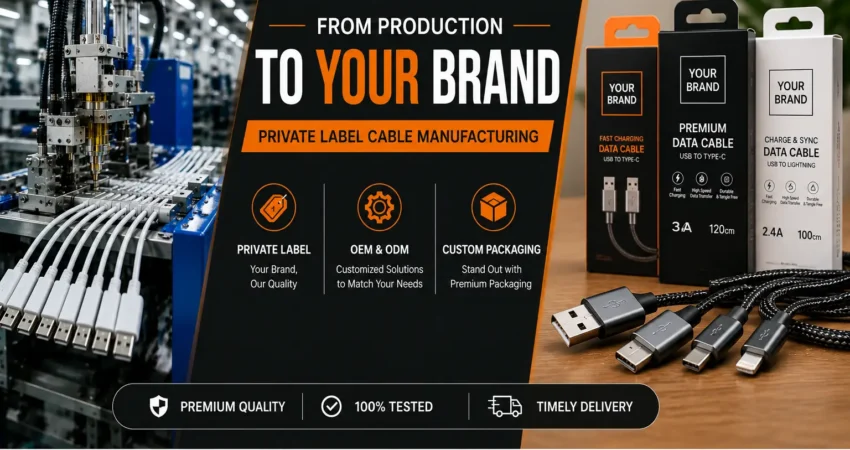
Introduction
The mobile accessories market has evolved rapidly over the last few years. What was once dominated by generic electronic products is now driven by branding, customization, and customer experience. Among all mobile accessories, charging and data cables remain one of the most essential and frequently purchased products.
Today, many businesses are moving beyond reselling generic accessories and are focusing on building their own identity through private label cable manufacturing.
From startups and online sellers to retailers and established electronics brands, businesses are increasingly launching their own cable products under custom brand names. This shift is creating new opportunities for companies that want to grow in the electronics industry without investing heavily in manufacturing infrastructure.
In this guide, we’ll explore how private label cable manufacturing works, why it has become so popular, and how brands successfully launch their own cable products in a competitive market.
Why the Cable Market Continues to Grow
The demand for charging and data cables continues to increase globally due to the growing use of smartphones, tablets, laptops, gaming devices and other smart electronics.
Major factors driving the market:
- Increasing smartphone users worldwide
- Growth of fast charging technology
- Higher demand for USB Type-C accessories
- Expansion of e-commerce and D2C brands
- Frequent replacement cycle of cables
Unlike many electronic products, cables are considered essential daily-use accessories. Because of regular usage, wear and tear are common, which creates repeat purchasing opportunities for brands.
This makes cable products highly attractive for businesses looking to enter the electronics and mobile accessories industry.
What is Private Label Cable Manufacturing?
Private label cable manufacturing is a business model where a manufacturer produces cables and businesses sell those products under their own brand name.
Instead of setting up a factory, machinery, production team and testing facility, businesses can partner with an experienced manufacturer and focus on branding, sales, and market growth.
In simple terms:
The manufacturer handles production, while the business builds the brand.
How Private Label Manufacturing Works
The process of launching a private label cable brand is much simpler than many businesses expect.
Step 1: Select the Product Type
Businesses first decide which cable products they want to launch.
Common options include:
- USB Type-C cables
- Lightning cables
- Micro USB cables
- Fast charging cables
- Multi-device cables
The choice usually depends on market demand, target audience and pricing strategy.
Step 2: Product Customization
Once the product is selected, customization begins.
Customization options may include:
- Cable material and finish
- Cable length
- Connector type
- Charging speed specifications
- Logo printing
- Packaging design
- Color combinations
This stage is important because customization helps brands differentiate themselves from generic market products.
Step 3: Sample Approval
Before bulk production begins, manufacturers provide product samples for testing and approval.
Businesses usually evaluate:
- Build quality
- Charging performance
- Durability
- Packaging appearance
- Branding accuracy
Testing samples helps ensure that the final product aligns with the brand’s expectations.
Step 4: Bulk Production
After sample approval, the manufacturer starts mass production.
At this stage, factors like production timelines, quality control, and packaging consistency become critical.
A reliable manufacturing partner ensures smooth production without compromising quality.
Step 5: Market Launch
Once production is complete, businesses launch the products through:
- Online marketplaces
- Retail stores
- Distribution networks
- E-commerce websites
- Corporate sales channels
Strong branding and marketing strategies help products gain visibility in a competitive market.
Why Businesses Prefer Private Label Cable Manufacturing
Private labeling has become one of the most preferred business models in the electronics accessories industry.
- Lower Investment Requirement
Setting up a manufacturing facility requires significant investment in machinery, labor, infrastructure and certifications.
Private labeling eliminates these upfront manufacturing costs.
Businesses can focus their budget on:
- Branding
- Marketing
- Sales
- Distribution
2. Faster Market Entry
Launching a product from scratch takes time. With private labeling, businesses can launch products much faster because the manufacturing infrastructure already exists.
This helps brands respond quickly to market trends and consumer demand.
3. Brand Ownership
Private labeling allows businesses to build their own identity in the market.
Instead of selling generic products, companies can create:
- Custom packaging
- Unique branding
- Premium product positioning
Over time, this helps improve customer trust and brand recognition.
4. Scalability
As demand grows, businesses can scale production without worrying about factory operations.
An experienced manufacturer can support:
- Small initial orders
- Large bulk production
- Long-term supply requirements
This flexibility is important for growing brands.
Also Read: Data Cable Manufacturer in India: A Complete Guide to Private Label, OEM & ODM Cable Solutions
Importance of Product Customization
Customization plays a major role in building a successful cable brand.
Consumers today prefer products that look premium, feel reliable, and represent quality.
Popular customization trends include:
- Braided cable designs
- Fast charging support
- Premium connector finishes
- Eco-friendly packaging
- Minimalistic branding
Customization not only improves product appearance but also increases perceived value.
The Role of Packaging in Brand Building
Packaging is often underestimated in the mobile accessories industry.
However, good packaging can strongly influence customer perception.
Benefits of premium packaging:
- Creates professional brand image
- Improves shelf visibility
- Enhances unboxing experience
- Builds trust among buyers
For online sellers, attractive packaging can also improve customer retention and repeat purchases.
How to Choose the Right Private Label Cable Manufacturer
Choosing the right manufacturer is one of the most important decisions for any brand.
Key factors to evaluate:
✔ Manufacturing Experience
An experienced manufacturer understands market standards, product quality, and production processes better.
✔ Quality Control Systems
Consistent quality is essential for long-term brand success.
Manufacturers should have:
- Product testing systems
- Durability checks
- Charging performance testing
✔ Customization Capabilities
A good manufacturing partner should offer flexibility in:
- Branding
- Packaging
- Product specifications
✔ Production Capacity
As your business grows, your manufacturer should be capable of handling larger orders efficiently.
✔ Delivery Reliability
Timely production and delivery are critical for maintaining business operations and customer satisfaction.
Future Trends in Private Label Electronics
The private label electronics industry continues to evolve with changing consumer preferences and technology.
Emerging trends include:
- Fast charging solutions
- USB Type-C dominance
- Eco-friendly materials
- Multi-functional accessories
- Smart packaging integration
Brands that adapt to these trends early can create stronger market positioning.
Vizin Cables: Supporting Businesses with Private Label Manufacturing
As demand for branded electronics grows, businesses need manufacturing partners that understand scalability, customization, and consistency.
Vizin Cables focuses on helping businesses launch and grow their own cable products through private labeling, OEM, and ODM manufacturing solutions.
With an emphasis on quality manufacturing, product customization and bulk production support, Vizin Cables works with businesses looking to create reliable and market-ready cable products.
From packaging customization to scalable manufacturing solutions, the goal is to help brands build products that align with their identity and market expectations.
Conclusion
Private label cable manufacturing has opened new opportunities for businesses to build their own brand without investing heavily in manufacturing infrastructure.
By combining:
- Strong branding
- Product customization
- Reliable manufacturing
- Scalable production
businesses can successfully compete in the growing mobile accessories market.
As the demand for high-quality charging and data cables continues to rise, brands that focus on quality, consistency, and customer experience will have a stronger competitive advantage.
Partnering with the right manufacturer can help businesses transform simple cable products into long-term brand assets.
FAQs
Q1. What is private label cable manufacturing?
Private label cable manufacturing allows businesses to sell cable products under their own brand name while production is handled by a manufacturer.
Q2. Is private labeling profitable in the mobile accessories industry?
Yes, private labeling can be highly profitable because it allows businesses to build brand value and achieve better margins compared to generic reselling.
Q3. What types of cables can be customized?
Businesses can customize USB Type-C cables, Lightning cables, Micro USB cables, fast charging cables, and multi-device cables.
Q4. Why is packaging important for cable brands?
Packaging helps create a professional image, improve customer trust, and enhance product presentation in both retail and online markets.
Q5. Can startups launch their own cable brand through private labeling?
Yes, private labeling is ideal for startups because it reduces manufacturing investment while allowing full branding control.
Q6. What should businesses check before selecting a manufacturer?
Businesses should evaluate manufacturing experience, quality standards, customization options, production capacity, and delivery reliability.
Q7. Does Vizin Cables support private label manufacturing?
Yes, Vizin Cables provides private labeling, OEM, and ODM cable manufacturing solutions for businesses looking to launch and scale their own branded products.
Q8. Can private label manufacturers handle bulk orders?
Experienced manufacturers can efficiently manage both small and large-scale production requirements depending on business needs.